
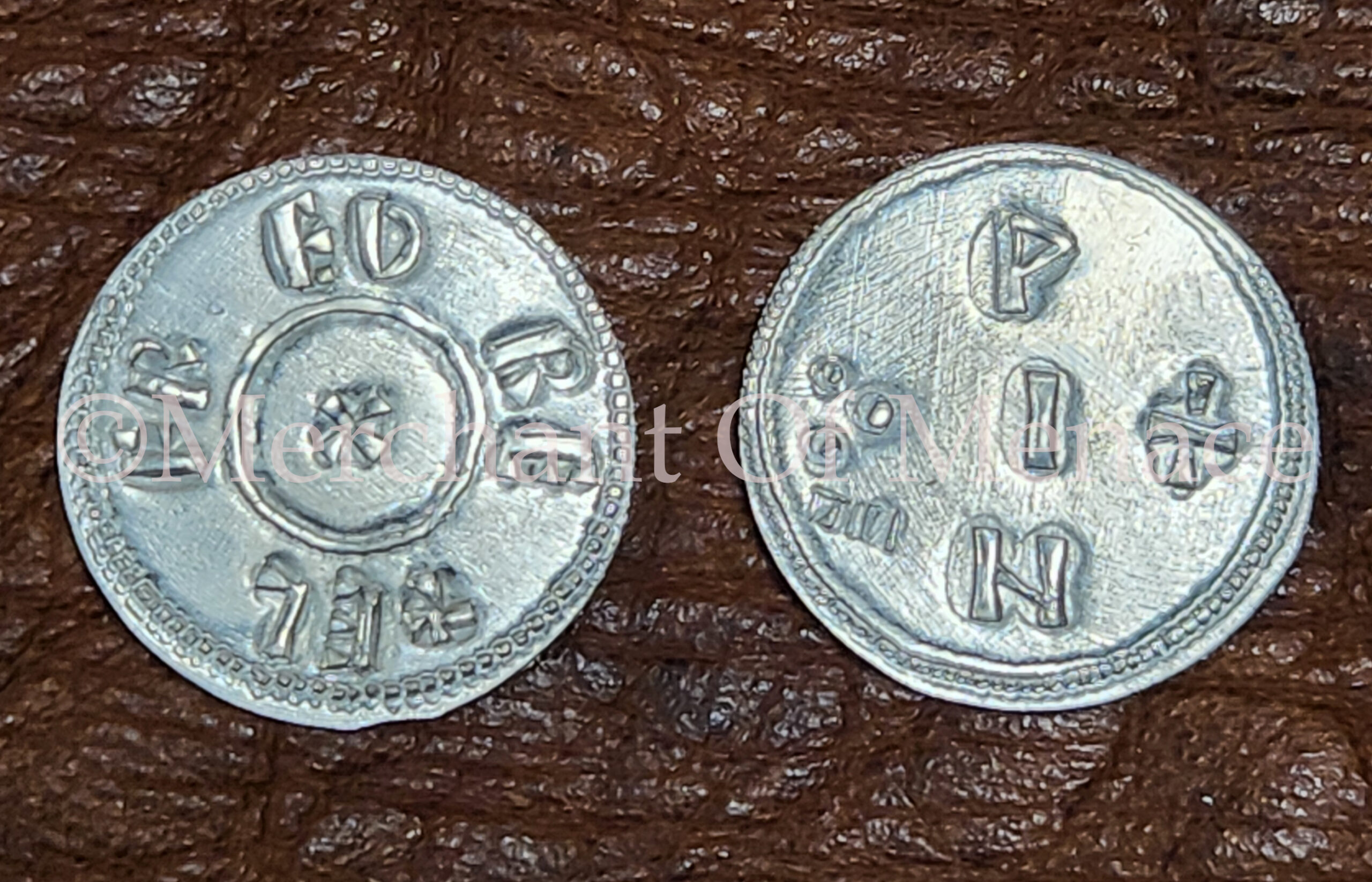
Description
Wessex Penny (Saxon), King Alfred The Great 871 – 899 AD, Winchester Mint
Provenance:
Coins of England & the United Kingdom, 44th edition, Spink, 2009, page 108 ref-1071
We are delighted to offer for sale these close copies of the original coin.
The Coin is hand struck with our own hand cut dies, The coin is available in either lead free English Pewter or Sterling Silver (925, 2.7 grams approx.)
These make a great addition to any pouch or Living history dice game, Suitable for all cultures of the period.
These coins are accepted for use within:
The Vikings (NFPS)
Regia Anglorum.
Many other Groups and Societies also accept these for use, if in doubt please check with your group/society Authenticity/Provenance Officer or refer to your kit Guides. If you would like to add your Group or Society to the above list please let us know
What do we know about KingAlfred?
Alfred the Great (Old English: Ælfrǣd [ˈæɫvˌræːd]; c. 849 – 26 October 899) was King of the West Saxons from 871 to 886, and King of the Anglo-Saxons from 886 until his death in 899. He was the youngest son of King Æthelwulf and his first wife Osburh, who both died when Alfred was young. Three of Alfred’s brothers, Æthelbald, Æthelberht and Æthelred, reigned in turn before him. Under Alfred’s rule, considerable administrative and military reforms were introduced, prompting lasting change in England.
After ascending the throne, Alfred spent several years fighting Viking invasions. He won a decisive victory in the Battle of Edington in 878 and made an agreement with the Vikings, dividing England between Anglo-Saxon territory and the Viking-ruled Danelaw, composed of Scandinavian York, the north-east Midlands and East Anglia. Alfred also oversaw the conversion of Viking leader Guthrum to Christianity. He defended his kingdom against the Viking attempt at conquest, becoming the dominant ruler in England. Alfred began styling himself as “King of the Anglo-Saxons” after reoccupying London from the Vikings. Details of his life are described in a work by 9th-century Welsh scholar and bishop Asser.
Alfred had a reputation as a learned and merciful man of a gracious and level-headed nature who encouraged education, proposing that primary education be conducted in English rather than Latin, and improving the legal system and military structure and his people’s quality of life. He was given the epithet “the Great” from as early as the 13th century, though it was only popularised from the 16th century. Alfred is the only native-born English monarch to be labelled as such.


